
Modern laboratories generate enormous quantities of data every day. From molecular biology and genomics to clinical chemistry, microbiology, analytical chemistry, and biotechnology, laboratory instruments continuously produce measurements that require careful analysis and interpretation.
As laboratory technologies become more sophisticated, researchers and laboratory professionals increasingly need digital tools capable of organizing, processing, and interpreting complex datasets. Artificial intelligence (AI) and machine learning are emerging as valuable technologies for supporting these processes.
What Is AI-Assisted Laboratory Interpretation?
AI-assisted laboratory interpretation combines laboratory data with computational methods designed to identify relationships, patterns, or abnormalities within datasets.
Traditional laboratory interpretation generally follows a structured process:
Sample → Measurement → Data → Quality Control → Analysis → Interpretation → Report
AI can introduce additional computational support into several stages of this workflow:
Sample → Measurement → Digital Data → AI-Assisted Analysis → Pattern Recognition → Human Review → Interpretation
The AI system may process information much faster than manual approaches, particularly when datasets contain thousands or millions of individual measurements.
Depending on the application, AI may be used for:
- Pattern recognition
- Data classification
- Anomaly detection
- Image analysis
- Signal processing
- Prediction
- Data clustering
- Automated quality-control support
- Literature-assisted interpretation
- Identification of relationships between variables
- Prioritization of results for further investigation
However, AI-generated outputs should be interpreted within the appropriate scientific context. Laboratory results depend on experimental conditions, sample quality, instrument performance, methodological limitations, and biological variability.
For this reason, AI-assisted interpretation should support scientific decision-making rather than automatically replace expert review.

Why Are Laboratories Turning to Artificial Intelligence?
The increasing adoption of AI in laboratories is closely connected to the rapid growth of scientific data.
A modern laboratory may generate information from multiple platforms, including:
- PCR and RT-qPCR
- Next-generation sequencing
- Mass spectrometry
- Chromatography
- Flow cytometry
- Microscopy
- Spectroscopy
- Microarray technologies
- Automated analyzers
- High-content imaging
- Proteomics platforms
- Metabolomics platforms
Each technology can generate complex datasets requiring different analytical approaches.
For example, a single sequencing experiment can produce a very large number of individual data points. Similarly, high-content microscopy can generate thousands of images that must be examined for specific cellular features.
Manually analyzing all this information can be time-consuming and difficult to scale.
AI-assisted approaches can help laboratories process these datasets more efficiently by identifying patterns and prioritizing information for human review.
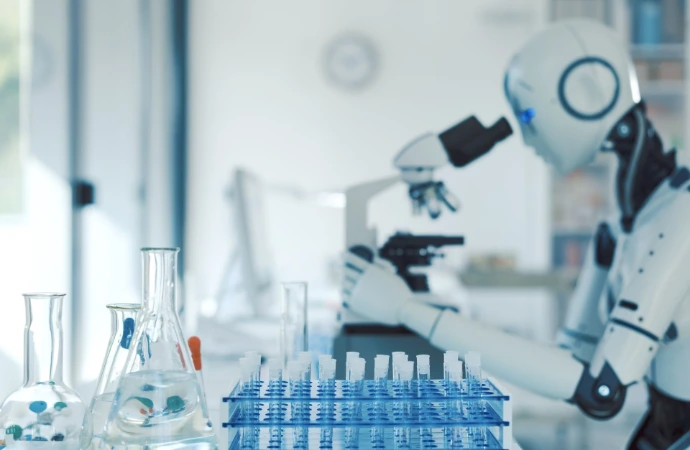
AI in Laboratory Data Analysis
One of the most important applications of artificial intelligence in laboratory environments is data analysis.
Laboratory datasets often contain multiple variables that may interact with one another.
For example, researchers may need to compare:
- Experimental groups
- Concentrations
- Time points
- Biological replicates
- Instrument measurements
- Molecular markers
- Cell characteristics
- Environmental conditions
Machine learning algorithms can analyze relationships between variables and identify patterns that may not be immediately obvious during manual analysis.
AI-Assisted Interpretation of Molecular Biology Data
Molecular biology is one of the areas where computational technologies have become increasingly important.
Laboratories working with DNA, RNA, and other molecular information can generate complex datasets that require sophisticated computational analysis.
AI-assisted approaches can support the interpretation of:
- Gene-expression datasets
- Sequencing data
- Molecular signatures
- Variant patterns
- Biomarker datasets
- Protein-related measurements
- Multi-omics datasets
For example, researchers studying gene expression may have measurements for thousands of genes across multiple experimental conditions.
AI and machine learning methods can help identify patterns across these measurements.
This does not automatically establish a biological mechanism. Instead, computational results can help researchers identify relationships that deserve further experimental investigation.
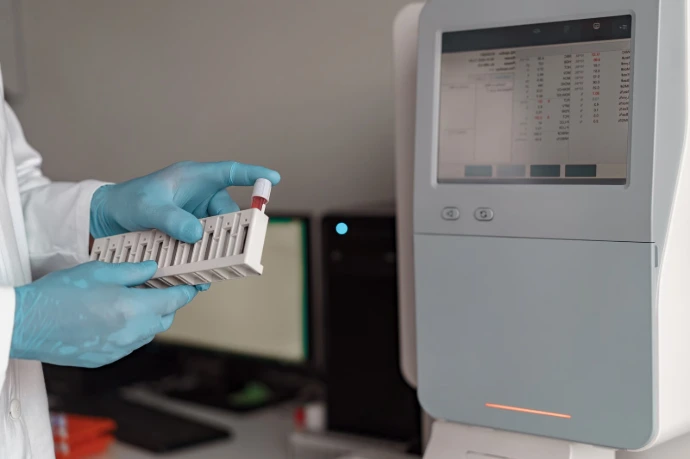
AI and PCR Data Interpretation
PCR and quantitative PCR are widely used molecular techniques that generate structured numerical data.
In RT-qPCR experiments, researchers may analyze amplification curves, threshold cycle values, normalization controls, and relative expression measurements.
AI-assisted systems could potentially support:
- Amplification curve analysis
- Identification of unusual amplification patterns
- Quality-control checks
- Classification of amplification profiles
- Automated organization of experimental datasets
- Detection of potential outliers
However, experimental interpretation still requires knowledge of the assay design, primer performance, controls, normalization strategy, biological replicates, and experimental context.
An algorithm cannot independently determine whether a molecular result is biologically meaningful simply because a numerical pattern has been detected.
AI-Assisted Microscopy and Image Interpretation
Laboratory imaging produces another major source of data.
Modern microscopes and imaging platforms can generate large numbers of images containing detailed information about cells, tissues, microorganisms, or experimental structures.
Traditional image analysis may require researchers to manually identify specific features.
AI-based computer vision can assist by detecting and classifying visual characteristics.
Applications may include:
- Cell detection
- Cell counting
- Segmentation
- Morphological classification
- Detection of cellular structures
- Measurement of fluorescence intensity
- Identification of image-based patterns
- Automated image quality assessment
For example, in cell-based research, an AI model may be trained to distinguish different cellular morphologies.
The model can then process large image collections and identify images requiring closer examination.
This can significantly reduce repetitive manual work while allowing researchers to focus on scientific interpretation.

AI in Microbiology
Microbiology laboratories also generate diverse datasets that may benefit from computational assistance.
AI-assisted approaches can potentially support the analysis of:
- Microbial images
- Growth curves
- Colony morphology
- Molecular profiles
- Spectral data
- Experimental datasets
- Microbial classification patterns
Machine learning can be particularly useful when large numbers of observations need to be classified according to multiple variables.
For example, image-analysis algorithms can be trained to recognize specific morphological characteristics in microbial cultures.
However, automated classification must be carefully validated before being incorporated into routine laboratory workflows.
AI and Analytical Chemistry
Analytical chemistry generates highly structured but often complex signals.
Techniques such as chromatography and mass spectrometry can produce datasets containing numerous peaks, retention times, intensities, and molecular signals.
AI can assist researchers in processing these datasets.
Potential applications include:
- Peak recognition
- Signal classification
- Pattern recognition
- Spectral interpretation
- Compound classification
- Anomaly detection
- Multivariate analysis
For example, machine learning can help analyze complex mass-spectrometry datasets by identifying combinations of signals associated with particular sample groups.
AI can therefore act as an additional computational layer between raw instrumental output and scientific interpretation. Read article
AI-Assisted Mass Spectrometry
Mass spectrometry is particularly suitable for computational analysis because it generates large quantities of numerical and spectral information.
Researchers may need to examine:
- Mass-to-charge ratios
- Signal intensity
- Fragmentation patterns
- Retention times
- Spectral similarities
- Molecular features
Machine learning algorithms can help identify relationships between these variables.
In metabolomics and proteomics, AI-assisted analysis may help researchers explore patterns across large collections of molecular measurements.
For example, computational models can be used to classify samples according to their molecular profiles or identify combinations of features that distinguish experimental groups.
These results can then guide additional laboratory investigations.
AI and Laboratory Quality Control
Quality control is another important area where AI may provide useful assistance.
Laboratory quality systems depend on identifying errors, inconsistencies, deviations, and unusual measurements.
AI-based systems can potentially assist with:
- Detection of unusual instrument readings
- Identification of unexpected patterns
- Monitoring of repeated measurements
- Detection of data inconsistencies
- Trend analysis
- Process monitoring
- Identification of potential anomalies
For example, if an analytical instrument normally produces measurements within a certain pattern, an anomaly-detection algorithm could identify unusual results for review.
This does not necessarily mean that the result is incorrect.
An anomaly simply indicates that the observation differs from expected patterns and may deserve investigation.Read article
AI and Anomaly Detection
Anomaly detection is particularly interesting in laboratory environments.
Laboratory datasets can contain unusual observations for many reasons:
- Instrument variation
- Sample degradation
- Contamination
- Pipetting errors
- Environmental changes
- Reagent variation
- Biological variability
- Technical errors
- Data-entry problems
AI algorithms can learn patterns from historical datasets and flag observations that differ significantly from those patterns.

For example:
Normal pattern → AI monitoring → unusual observation → human review → investigation
This approach can help laboratories prioritize which results require additional attention.
However, an algorithm should not automatically label an unusual result as an experimental failure.
Scientific investigation remains necessary.
AI-Assisted Laboratory Reporting
Laboratory workflows often involve transforming raw data into structured reports.
AI-assisted systems can potentially help organize information from multiple sources.
For example:
Instrument data + Quality-control information + Experimental metadata + Analytical results → Structured report
AI tools may assist with:
- Data organization
- Summary generation
- Identification of relevant observations
- Formatting
- Comparison with historical datasets
- Highlighting unusual results
For research laboratories, this can reduce repetitive administrative work.
Nevertheless, automatically generated text should be reviewed carefully, especially when reports contain scientific conclusions or information that may influence experimental decisions.
The Role of Natural Language Processing
Not all laboratory data are numerical.
Laboratories also produce large quantities of textual information, including:
- Research articles
- Experimental protocols
- Laboratory notes
- Technical documentation
- Instrument manuals
- Standard operating procedures
- Scientific reports
- Databases
Natural language processing, or NLP, allows AI systems to analyze and organize text.
Potential laboratory applications include:
- Searching scientific literature
- Extracting scientific information
- Organizing documents
- Summarizing technical information
- Identifying relevant publications
- Connecting laboratory terminology
- Supporting knowledge retrieval
For researchers working in rapidly evolving scientific fields, AI-assisted literature analysis can help organize large amounts of information.
However, scientific references should always be verified against the original publication.
AI and Multi-Omics Interpretation
Modern biological research increasingly combines multiple layers of molecular information.
These may include:
- Genomics
- Transcriptomics
- Proteomics
- Metabolomics
- Epigenomics
This approach is commonly referred to as multi-omics.
Integrating multiple datasets can be challenging because each layer has different characteristics, scales, and sources of biological variability.
AI and machine learning can provide computational methods for exploring relationships across these datasets.
For example:
Genomic data + Transcriptomic data + Proteomic data + Metabolomic data
can be analyzed together to identify complex patterns.
AI does not automatically explain the biological meaning of these relationships, but it can help researchers identify hypotheses that can subsequently be tested experimentally.
AI-Assisted Biomarker Research
Biomarker research is another area where AI-assisted laboratory interpretation can be valuable.
A biomarker dataset may contain measurements from many molecules across multiple samples.
Researchers may want to determine which combinations of variables are associated with specific biological conditions or experimental groups.
Machine learning can assist with:
- Feature selection
- Classification
- Pattern recognition
- Dataset clustering
- Predictive modeling
- Candidate biomarker identification
A computationally identified candidate biomarker still requires appropriate experimental validation.

This distinction is essential:
AI can identify a candidate pattern; laboratory research must determine whether that pattern is scientifically and biologically meaningful.
independent evidence.
Conclusion
AI-assisted laboratory interpretation represents an important development in modern laboratory science.
From molecular biology and genomics to microscopy, microbiology, analytical chemistry, and biotechnology, artificial intelligence can help laboratories process increasingly complex datasets.
Its potential applications include pattern recognition, anomaly detection, image analysis, molecular-data interpretation, quality-control support, and integration of multiple sources of information.
However, successful AI implementation requires more than sophisticated algorithms.
Reliable laboratory data, appropriate experimental design, validation, data governance, transparency, and scientific expertise remain essential.
The most valuable approach is therefore not AI instead of scientists, but AI together with scientists.
By combining computational capabilities with laboratory expertise, modern laboratories can develop workflows that are more efficient, scalable, and capable of handling increasingly complex scientific datasets.
AI-assisted laboratory interpretation should ultimately be viewed as a tool that helps researchers ask better questions, identify meaningful patterns, and focus their expertise where it is most valuable: understanding science and generating reliable knowledge.